A glass of red wine on the light-coloured sofa after dinner. The first reflex is almost always the same: a paper napkin, hard rubbing, then hot water and whatever stain remover turns up in the bathroom. Yet the first few minutes are decisive, and in those minutes a hasty rescue can do more harm than the stain itself. We have put together what you can deal with at home, what is best avoided, and when it is better to leave the upholstery or carpet to a professional.
The first five minutes
- Lift the solid part with a spoon or a blunt edge, working towards the centre of the stain so that it does not spread.
- Blot up as much as you can with a clean, white, absorbent cloth: from the edge of the stain inwards, pressing rather than rubbing.
- If the stain allows, use a little cold or lukewarm water, then blot again; the upholstery must not be soaked through.
- If a cleaning product is needed, test it first on an area that isn't visible.
- Leave the surface to dry naturally, without a hairdryer or radiator: heat can also set the stain.
- If the stain is still visible after this, there is no point trying one product after another.
Why not scrub?
Rubbing spreads the stain and works it deeper between the fibres, where it is no longer on the surface but in the filling or the base of the carpet. The fabric surface can also be damaged in the process: the fibres pill, the surface turns shiny or fades, and that mark remains visible even if the stain itself has come out. When you blot, the cloth absorbs the liquid; when you rub, it just moves it around. For the same reason, turn the cloth to a clean section often: a saturated cloth no longer absorbs, but returns the stain to the fabric.
Most lasting stains are not caused by the spill itself, but in the rush to salvage things: from rubbing, hot water or the wrong product.
Test in a hidden spot
Whatever the product, always test it on a hidden area first. Upholstery fabrics and dyes vary greatly, and what works on one can cause discolouration on another.
Where is it worth trying?
- on the back or lower edge of the sofa
- on the underside of a removable cushion
- in a corner of the carpet under the furniture
What should you look out for?
After a few minutes, press a white cloth onto the test spot. If the cloth picks up colour, the dye is running, and that product must not be used on visible areas. The same applies if the fabric's feel, sheen or colour changes. If the furniture has a care label, check that too before anything touches the upholstery.
The stain map
| Stain | Step one | To avoid |
|---|---|---|
| Coffee, tea | Blot immediately, then lukewarm water | Hot water can set the stain |
| Red wine, fruit juice | Blot immediately, a little cold water, blot again | Scrubbing, hot water |
| Blood, milk, egg and other protein-based stains | Cold water only | Hot water: it “cooks” the stain into the fibres |
| Grease, oil, butter | Blot; solvent-based products only after a test on a hidden area | Solvent without a patch test, lots of water |
| Chocolate | Scrape off the solid part, then blot | Heat, rubbing |
| Chewing gum | Harden with ice, then carefully chip off | Scraping while still warm |
| Pet urine | Blot quickly, with a little cold water | Ammonia-based products: the smell can draw the animal back |
| Ink, paint | Rarely removed without a trace at home — best left to a professional | Scrubbing, mixing products |
| Old stain of unknown origin | Best left to a professional | Guesswork with different products |
What to avoid
- bleach on coloured fabrics
- soaking the upholstery through: the lining dries slowly and can develop an odour
- mixing different cleaning products: some combinations give off gases that are harmful to health
- heat while the stain is still in: hairdryer, iron, radiator
- too much stain-remover spray in one spot: product left in the fabric attracts new dirt, and the area gets dirty again more quickly
- coloured cloth or sponge: its dye can transfer to light upholstery
When do you need a professional?
If the stain is old or covers a large area, if the upholstery is made of a delicate material, if it is still visible after your own attempts, or if the liquid has soaked below the surface into the filling or the lining, machine deep cleaning will help. The same applies to stains that come with an odour, for example from pets: there, besides the visible stain, the odour left in the fabric also has to be treated.
To be honest: not every stain disappears without a trace. Most do, but with old, set-in stains we tell you at the assessment what to expect before any work begins.
What does the machine do differently?
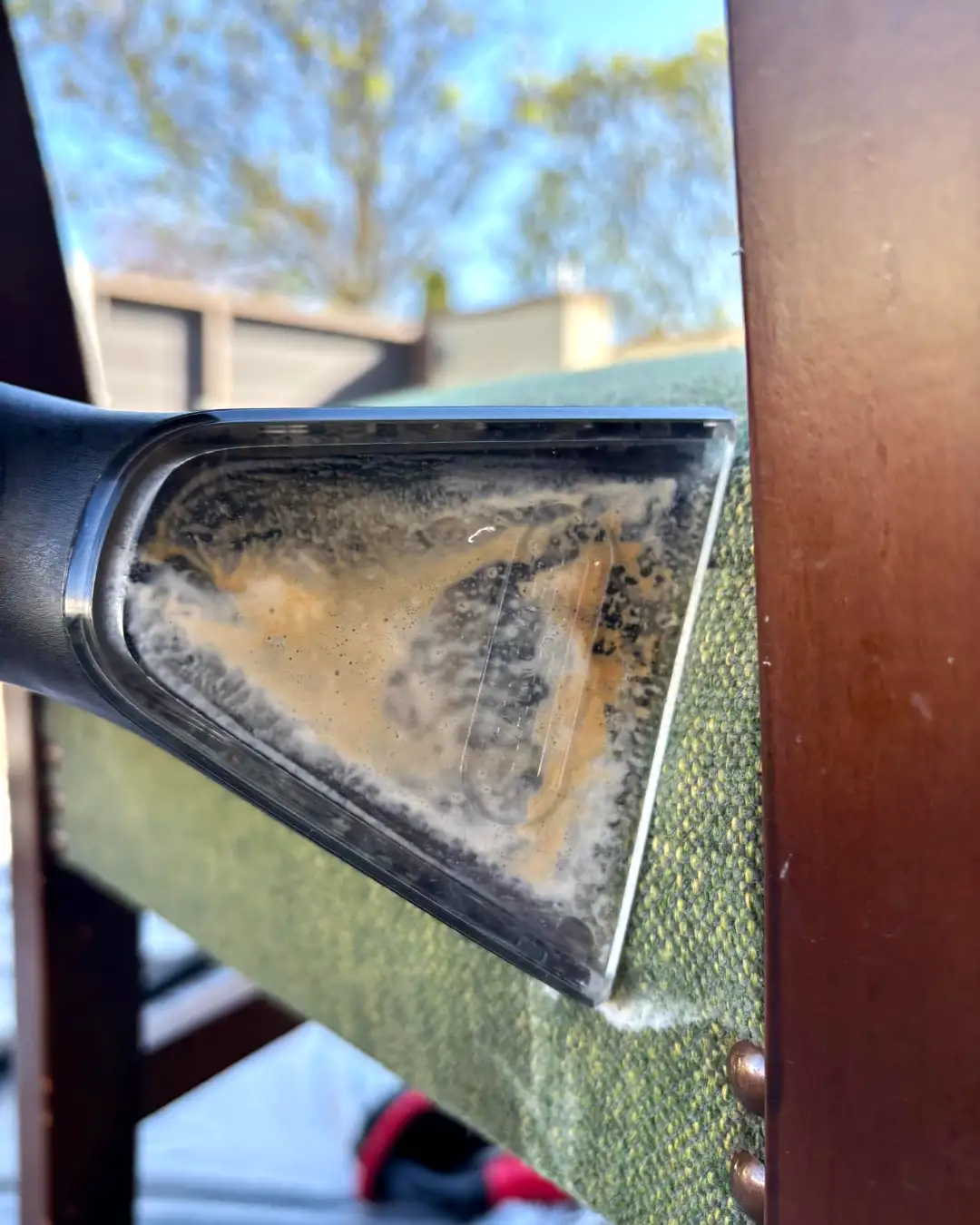
We use a Kärcher Puzzi 8/1 spray-extraction machine. Stains are first pre-treated with a product chosen for the type of stain, which we test beforehand on a hidden area. The machine then works the cleaning solution into the fibres and extracts it together with the loosened dirt. Because it also extracts the moisture, the upholstery does not get soaked, and at the end of the job we tell you when the furniture can be used again. Odour neutralisation is also available after pets, tobacco smoke or damp.
The recommended frequency of regular upholstery deep cleaning is covered in the article on sofas, mattresses and rugs . In a rental flat, upholstery is also part of the guest turnover routine; there is more on this in in this guide for more.
What to have at home
The key lesson of the stain map is simple: reacting well takes not a special product, but a few things within reach. One or two white, absorbent cloths, a spoon, cold water, and enough patience not to rub. Remember this, and most stains can be kept to a manageable size in the first few minutes.