In a review, guests rarely write that the accommodation was clean, because they take it for granted. If it wasn't, however, they almost always mention it. Cleanliness is therefore an asymmetric factor: when it is right, the property earns no special credit for it; when it falls short, the property loses a great deal.
For the host, this is an awkward position. Good work goes unnoticed, and a mistake cannot be explained away afterwards, because the review has already been published. So it is worth understanding what guests pay attention to, and why the same complaints keep coming up.
Why no praise, and why is it written anyway?
Guests treat cleanliness as a given, just like hot water or a working lock. We don't reward what is a given; we only notice when it is missing. Booking platforms also ask about it specifically: Airbnb, for example, asks guests to rate cleanliness as a separate category in their review, alongside accuracy, communication and value.
Cleanliness rarely earns praise, but a lack of it almost always noted.
This leads to the most important practical lesson: in guest turnover, what counts is not the average visit but the weakest one. However good the rest of the season's turnovers were, each guest only sees their own.
The first few minutes
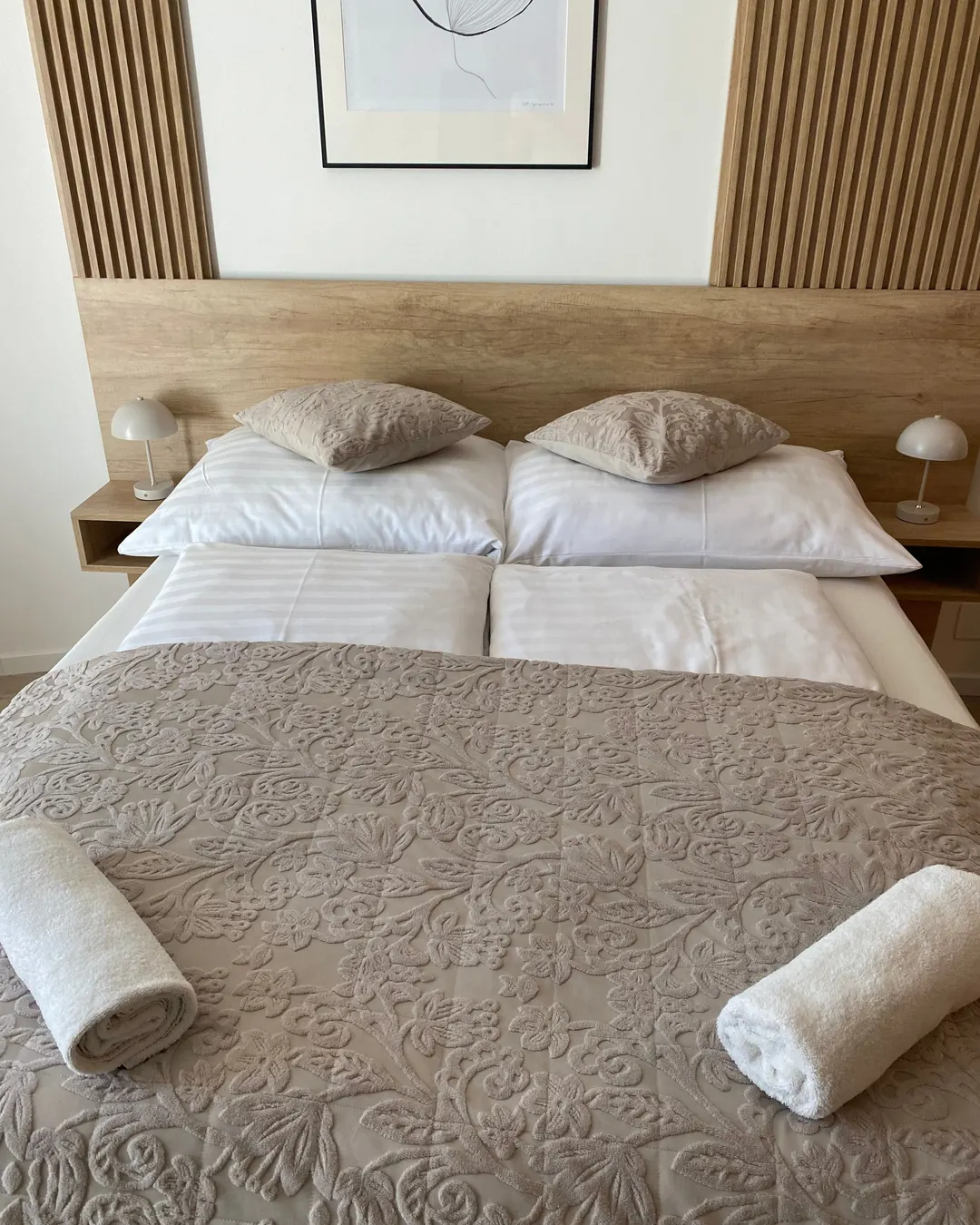
When guests walk in, they don't take in the apartment as a whole; they notice the details. A single hair or a limescale mark makes a stronger impression than the best photo in the listing, because it shows how much care went into the place. These are the spots the eye usually falls on first:
- the bathroom mirror, the washbasin and the tap
- the pillowcase and bed linen, close up
- the sink and the kitchen worktop
- the corners of the floor and the area under the bed
- how the apartment smells: aired, neutral or stale
The last point is often underestimated. Smell is part of the first impression, before the guest has even looked at anything, and no strong air freshener can mask a flat that has not been aired. A neutral, well-ventilated flat says more about cleanliness than any fragrance.
A guest with an eye for detail isn't looking for faults; they simply notice them. So the question isn't whether the apartment is clean overall, but whether these points were covered at every turnover.
Behind the complaints lies an organisational failure
None of the most common cleanliness complaints involves a major cleaning task. Each one stems from a single item being skipped, which means the fault is usually organisational, not a matter of skill. So the solution is not greater effort, but a more precise checklist.
| What guests notice | What gets missed behind it | What prevents it |
|---|---|---|
| Hair or lint on the bedding or the floor | Checking the bedding; the floor under the furniture | The floor comes last; after making the bed, one final check |
| Limescale in the shower and on the taps | No regular descaling, just wiping | Products suited to the surface, at every turnover |
| Smeared mirror, glass covered in fingerprints | The final wipe-down | Mirrors and glass are among the last items on the checklist |
| Crumbs, greasy kitchen surfaces | Inside appliances, fridge shelves | Kitchen items listed separately |
| Missing basic equipment | No record of what is put out, or how much | Set-up list for each apartment |
| The previous guest's belongings | The walk-round before cleaning | A walk-round and photos before we touch anything |
What creates a sense of cleanliness beyond the cleaning
Guests don't distinguish between 'clean' and 'tidy', nor do they separate the condition of the textiles from the cleaning. A worn, greying towel looks neglected even when freshly washed, as does a stained sofa or a tired rug. It is therefore worth maintaining textile surfaces with deep cleaning timed to the season; we explain how often in our separate guide .
The same applies to hard-to-reach spots. The top of a wardrobe, the fins of a radiator or the corner of a window frame don't fit into a turnover, but guests may notice them. Before the season opens and at its end, these are dealt with by a deep clean puts right.
The same standard every time
In an apartment, guest turnover is a process repeated throughout the season. Two things hold the quality together: every apartment has its own rules (what goes where, what needs restocking), and the same checklist is run every time. We work with apartment-specific rules, a permanent team and a photo sign-off, so the host can see the result even when they are not on site.
In our first Balaton season, monthly volume grew many times over from April to August, and guest feedback on cleanliness stayed consistently good even at peak times; the details are described in the case study . How a turnover runs, step by step, is set out in in this guide .
What can hosts do?
- Set out in writing the condition in which the flat should be handed over: how the linen is arranged, which supplies should be laid out and the flat's known weak spots.
- Take a photo of the finished apartment and use it as the benchmark: guests compare it with the photos in the listing.
- If a guest comments on cleanliness, trace the remark back to the checklist: which point was missed, and why.
- Schedule deep cleaning and deep textile cleaning before and after the season, so that turnovers don't have to battle built-up dirt.
So the goal is not for guests to praise the cleanliness. It is for it never to cross their minds to mention it, so that the review focuses on the apartment, the view and the hospitality.