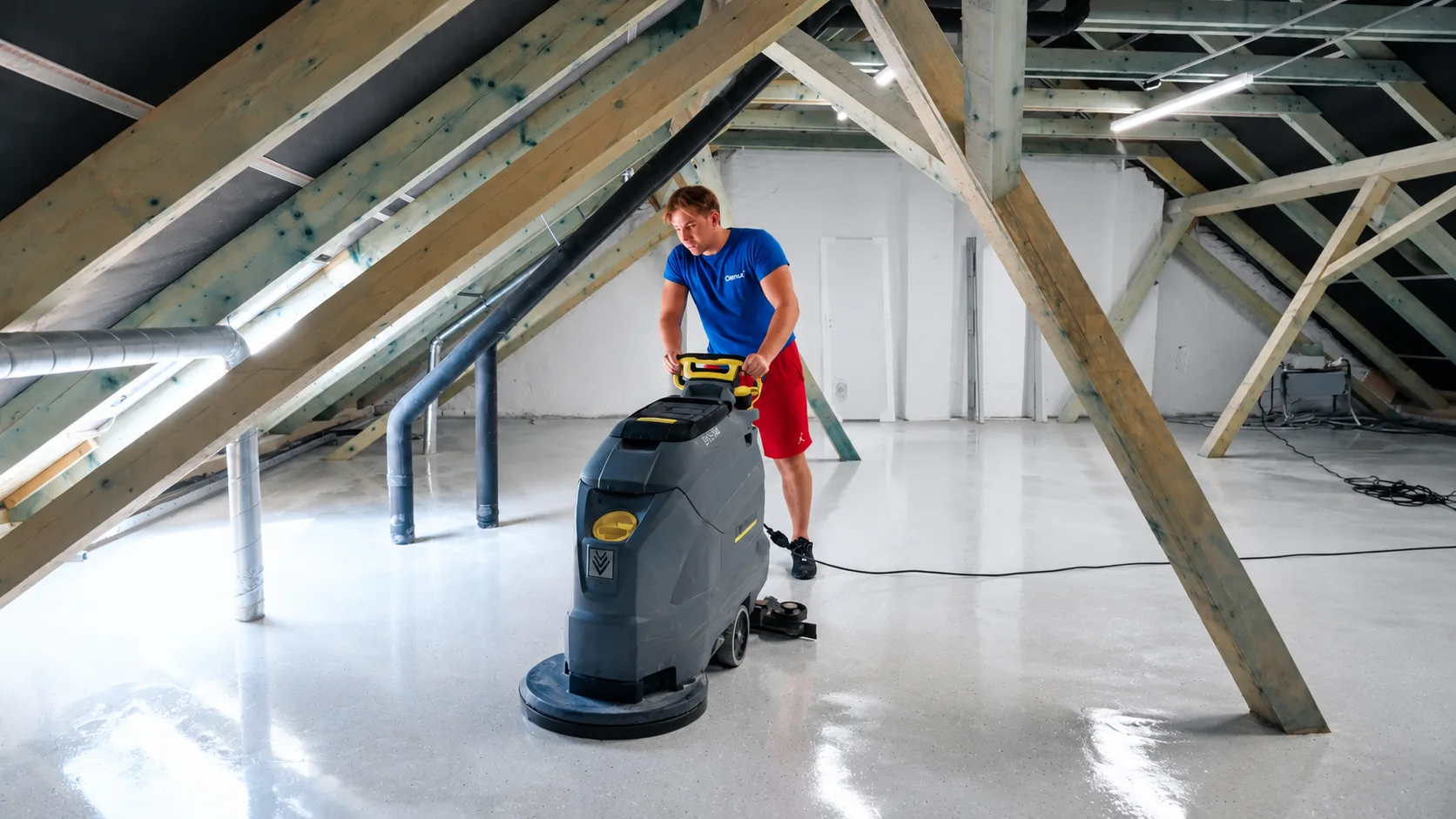
The tiler finished on Monday, the electrician fitted the last switches on Tuesday, and handover is on Thursday. The space is finished but not yet usable. Fine construction dust sits on the shelves, between the radiator fins and in the air-conditioning grilles; there are plaster and paint marks on the floor, and labels and protective film on the windows. At this point most clients think of a single thorough clean. Experience shows otherwise: post-construction cleaning is a sequence of stages that build on one another, each with a different purpose.
Why can't it be done in one go?
Construction dust behaves differently from household dust. Its particles are tiny, stay airborne for a long time and settle on already cleaned surfaces hours after cleaning. If the whole space is done in a single day, a shelf wiped in the morning is dusty again by evening. On top of that, in the final weeks every trade is working at once: what we clean today, the painter or the fitter may dirty again tomorrow. That is why we align the cleaning with the construction schedule and split it into stages.
Construction dust is not merely an aesthetic issue, either. According to guidance from the UK Health and Safety Executive (HSE), it is more than a nuisance: breathing it in regularly can lead to lung disease in the long term. So the dust should not be stirred up, but collected.
| Section | When | Purpose | Typical jobs |
|---|---|---|---|
| 1. Rough clean | During construction, between trades | A clear space that is safe to walk through | Construction waste, packaging, coarse dust, paint stains and splashes |
| 2. Fine | After installation work, before handover | Residue-free surfaces | Paint, plaster and adhesive residue, labels and film, floor surface treatment, dust removal with HEPA-filtered machines |
| 3. Final | Immediately before handover | Ready to hand over and move into | Sanitary fittings, kitchen surfaces, inside cupboards, floors right into the corners |
1. Rough clean: order between the trades
In the first stage, construction waste, packaging and coarse dust are removed, and this is also when we start removing paint stains and splashes. Smaller jobs may still be under way, so the aim is not final cleanliness but a space that is clear and safe to walk through for the next trades. In a tidy work area, defects also show up sooner: the contractor notices in time if a floor finish has been damaged or a fitting is missing.
2. Fine cleaning: the detail stage
In the second stage, every surface is covered, from switches to door frames and radiators. This is where it is decided whether the space merely looks tidy or is genuinely clean.
Dust: from top to bottom, in several passes
The most stubborn opponent is construction dust. We work downwards in several passes with a HEPA-filtered machine, starting with high surfaces, light fittings, air-conditioning and ventilation grilles and the top edges of doors. The filter is what matters: an ordinary vacuum cleaner returns some of the fine dust to the air, from where it settles back on surfaces that are already clean.
Residues: with a product suited to the flooring
Paint, plaster and adhesive residue may only be removed using a non-damaging method. What works on porcelain tiles can leave a stain on a resin or PVC floor, so we always choose the product and the tool to suit the surface. Where the surface is already damaged, we clean up to that limit and flag it with photos at handover. That way, no one has to work out at the end of the clean when and by whom a scratch was caused.
Glass: labels, film, frames
Dirt left on windows and glass walls is the first thing noticed at handover. Protective film and labels must be removed without damaging the frame or the glass, so we do the glass cleaning together with the fine clean. We have covered the technique for a streak-free finish in a separate article .
3. Final cleaning: ready for handover and move-in
The aim of the final phase is to make the space ready for handover and move-in. This is when the bathrooms and toilets are done (taps, tiles, mirrors and silicone, free of limescale and grout residue), followed by the kitchen surfaces, the inside of cupboards and finally the floor, right into the corners, with machine cleaning suited to the type of flooring. At the end, we produce photos of every room, a handover report and a list of defects that cleaning cannot fix.
Between the fine and final stages, it is worth waiting for the airborne dust to settle. If the final round starts too early, a thin layer of dust will reappear on freshly wiped surfaces by the next day.
The quality of post-construction cleaning depends on the sequence: anything we clean too early has to be cleaned again.
What the client can prepare in advance
- the schedule: when each trade finishes and when the handover takes place
- a list of surfaces: the types of flooring, wall coverings and glass
- access to electricity and water for the duration of the cleaning
- who signs off the work, and what documentation they expect
- existing damage, so that it doesn't come to light only after the cleaning
If these are available at the on-site walk-through, the phase boundaries and the team size can be planned precisely.
A real project in numbers
The care home in Százhalombatta shows clearly why you need to think surface by surface. In the converted and extended building, resilient PVC and rubber flooring, porcelain tiles and resin alternate; the wet rooms are tiled to door height, and the communal areas have large glass walls. Each calls for a different product and method, and construction dust is everywhere.
1 922 m²
floors: PVC and rubber 1 504, resin 364, porcelain tiles 54 m²
726 m²
wall tiles in wet rooms
418 m²
glazed windows, doors and glass walls
We split the work into two phases, with a large crew, aligned with the construction schedule. Both phases closed with photo documentation and a signed certificate of completion. We explain exactly what this documentation consists of, and why it is worth more than a few nice photos, in in this article in detail.
If the renovation was in a single flat, the same logic applies on a smaller scale; we have set out the order of steps before moving in here . The mark of good post-construction cleaning is not that the space sparkles, but that there is nothing to point out when the client walks through at handover.