At the handover walk-through, someone stops in a corridor and points to a paint stain on the floor. Who left it? The painter, the tiler, or was it missed in the cleaning? If the answer relies on memory alone, the question turns into a dispute. But if there is a dated photo of the same corridor after cleaning, the answer is clear at a glance.
For a construction client, then, a clean building is not enough. At handover, they also need to show what was done, when and to what extent. Cleaning thus becomes part of the project documentation, just like any other trade's work.
Why does a clean need evidence?
On a larger project, several subcontractors work one after another and side by side, and at handover the question often arises of who is responsible for a particular defect or soiling. If every step of the cleaning is recorded, these questions can be settled quickly, because the answer lies in the photos and documents, not in the memories of those involved.
The documentation also helps the client with their own client: the contractor can forward the cleaning records directly to the investor or developer, without having to piece together afterwards what happened on site.
Elements of the documentation chain
The evidential value does not come from a single document but from the way the documents refer to one another: the quote records what we committed to, the photos show that it was done, and the signature closes it off.
| Document | When it is produced | What it certifies |
|---|---|---|
| Itemised quote | After the walk-through, before the work | The agreed scope: rooms, surfaces, phases |
| Price breakdown | With the quote, if the client requests it | What the bill is made up of |
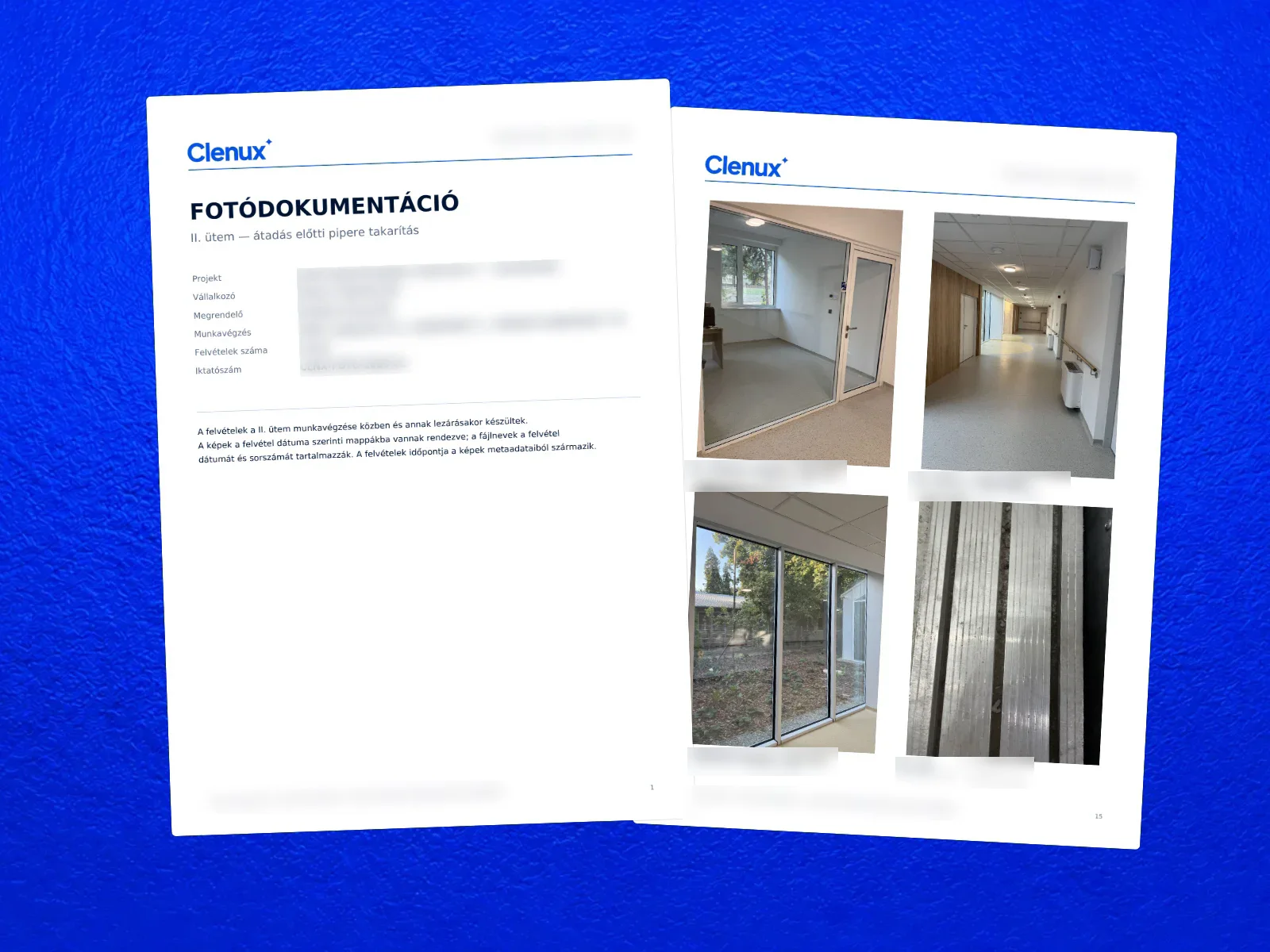
| Time-stamped photo documentation | Before and after work, room by room | The condition of the space before and after cleaning |
| Handover report and snag list | At handover | Anything cleaning cannot repair, such as paint damage or scratches |
| Signed certificate of completion | Per phase, at the end of the job | Confirmation that the work is complete, signed by both parties |
Photos that genuinely prove something
Useful photo documentation is not a random collection of pictures. A gallery of several hundred images on a phone is useless just when you need it: you cannot tell which room, which day, before or after. A photo series that serves as evidence follows a few simple rules.
- Prepared room by room, with each room's identifier — ideally the same one used on the plans and in the quote.
- The before and after photos are taken from the same angle, so that they can be placed side by side.
- It is time-stamped, so the date is not a claim made after the fact.
- Wide and close up: the wide shot identifies the room, the close-up the detail, a corner, a grout line, a frame.
- It is handed over sorted by date and compiled into a single document, so the client can leaf through it rather than search.
If it isn't documented, it can be disputed at handover.
Where documentation typically slips
- only an ‘after’ photo is taken, so there is nothing to compare it with
- the room names in the photos differ from those on the plan, so the images cannot be matched
- the certificate of completion is issued in one go at the end of the project, even though the work was carried out in phases
- the list of defects is only mentioned verbally during the walk-through, and afterwards nobody remembers it exactly
Each is a small thing, and each leads to the same place: the documentation exists, but it fails to answer the very question in dispute. That is why the rules for the photo series and the format of the documents should be agreed at the start of the work, not the day before handover.
What goes on the defect list?
Cleaning does not repair: it will not remove a scratch, a chipped tile corner or damaged paintwork, but it does make them visible. That is why, at handover, we provide a list of defects covering everything that cleaning cannot fix. Where a surface is already damaged, we clean as far as cleaning can go and record this with a photo. If something was missed on the cleaning side, we put it right.
For the contractor, this list is a working tool: they can see what needs putting right before the final handover, rather than discovering it during the client's walkthrough. The same logic works in other areas too; we have written separately about what a disinfection report contains is covered separately.
A real example: the care home's two phases
The care home in Százhalombatta pre-handover cleaning followed the same chain in both phases: an itemised quote with price justification; 16 pages of time-stamped photo documentation, sorted by date, showing the condition before and after the work; and finally a certificate of completion signed by both parties. The client can therefore trace every completed item in photos and documents.
2 339 m²
gross floor area, ground floor and loft
22
room units in the converted and extended building
2
phases, each with a signed certificate of completion
16
pages of photo documentation, sorted by date
How the work itself divides into stages, from the rough clean to handover, is explained in about the three stages of post-construction cleaning .
What to mention when you request a quote
- in what format the client wants the photo documentation, and who it needs to be sent to
- whether a quote needs to include a price justification
- whether you want the certificate of completion for each phase or as one at the end of the job
- who signs off the handover on the client's side
For business clients, documentation is part of the job, not an afterthought: it is produced at the same time as the cleaning. Its value lasts beyond the handover. Months later, in a warranty query or a tenant complaint, you can still show the condition in which the space was handed over.